Do Deer Move in Cold Fronts? What the Science — and the Stand — Actually Tell You
Cold fronts are the closest thing deer hunting has to a guaranteed play. Not because they always work, but because the biology behind them is real — and knowing the mechanics will put you in the right place at the right time more often than not.
Why Deer React to Cold Fronts at All
Before you can hunt a cold front effectively, you need to understand what the deer are actually responding to. It’s not the temperature. Not exactly. The trigger is barometric pressure — and whitetails are far more sensitive to it than most hunters realize.
Illinois biologist Keith Thomas documented this in detail. His research found that the greatest whitetail feeding activity occurred when barometric pressure fell between 29.80 and 30.29 inches of mercury. Within that window, deer moved best when pressure sat between 29.90 and 30.30 inches, with peak movement clustering at the higher end — 30.10 to 30.30 inches. The kicker: a rapid pressure drop of 4 to 5 tenths of an inch triggered the greatest single burst of movement activity.
That last point is everything. It’s not just where the pressure is — it’s how fast it’s moving.
Cold fronts bring exactly that: a fast, steep drop in barometric pressure ahead of the system, followed by a sharp rise once the front passes and skies clear. The deer’s internal alarm goes off on the way down, not on the way up. And that’s what creates the pre-front feeding frenzy that every serious whitetail hunter should be hunting.
The Three Phases of a Cold Front — and What Deer Do in Each
Understanding cold front deer movement means breaking it into three distinct windows. Each one demands a different strategy.
Phase 1: Pre-Front Surge (24–48 Hours Before Arrival)
This is arguably the most underrated hunting window in the whitetail calendar.
Here’s what’s happening: barometric pressure begins dropping well before any storm arrives. The sky might still be blue, the temperature might not have budged, but the deer can feel it. They respond by feeding aggressively — packing in calories before conditions deteriorate. Research and decades of hunter observation align on this: activity increases dramatically in the 24 to 48 hours before a cold front makes landfall.
For Southern hunters, this window is especially valuable. In Alabama, Mississippi, Georgia, and the Carolinas, you might have a front rolling through in early November that’s going to drop temps from the mid-60s into the low 40s. The 36 hours before that happens? That’s when you need to be in a stand over a food source or a well-used travel corridor.
Check your local forecast and watch the pressure trend on a weather app that shows barometric data. When you see pressure beginning to fall and a front is 24–48 hours out, clear your calendar.
Phase 2: During the Front — Hunker Down
Movement drops hard when the front actually passes.
High winds, precipitation, rapidly shifting temperatures — deer push into heavy cover and stay put. This isn’t laziness. It’s energy conservation. A whitetail’s entire existence is about managing its caloric budget, and burning energy moving around in driving rain or 30 mph gusts is a losing proposition.
Penn State’s Deer-Forest Study, led by researcher Duane Diefenbach, added an important nuance here using GPS-collar data. Their findings showed no statistically measurable difference in total distance traveled by deer before, during, or after a front. That’s a significant caveat — and it’s one worth sitting with.
What the collar data can’t fully capture is daytime movement patterns or whether deer are moving through areas hunters can access. An adult buck might cover his usual ground at 2 a.m. regardless of a front, but that doesn’t help you in a stand at 7 a.m. The National Deer Association has noted that GPS science is still evolving in its ability to parse these nuances, and the honest answer is that we don’t have the full picture yet.
What we do know from the field: the middle of a cold front is typically a poor time to be in the woods. Save the PTO for the other two windows.
Phase 3: Post-Front Clear — The Prime Window
If there’s one moment that consistently produces big deer in cold weather, it’s the first clear, crisp morning after a front blows through.
The barometer is rising. Skies have cleared. Temperatures have dropped into what deer find comfortable — roughly 40°F to 60°F for Southern whitetails. That combination unlocks movement that borders on reckless. Bucks that have been bedded through the storm are hungry, and in the rut they’re running hard on does that are themselves moving to feed.
Mississippi State University research found that temperature alone doesn’t drive deer movement in a statistically significant way. But temperature interacting with a rising barometer post-storm? That combination is where the action stacks up. The deer aren’t just moving — they’re moving during shooting hours.
This is your red-letter morning. Post-front Day 1, first legal light, right stand, right wind. There’s no better setup in deer hunting.
Temperature’s Role: Real, But Secondary
Temperature matters, but not in isolation.
Southern deer are adapted to warmer baselines than their northern counterparts. A whitetail in Georgia or Arkansas spending October in 70°F weather will respond to a drop into the 50s differently than a Wisconsin deer that’s been in 40°F conditions for weeks. What triggers Southern deer isn’t necessarily a specific number on the thermometer — it’s the delta.
Research suggests that a drop of 10 to 15°F from recent average temperatures is enough to trigger increased daytime movement in whitetails. So if your hunting area has been sitting in the upper 60s and a front knocks it down to the low 50s, that’s meaningful. If you’ve already had two cold snaps and temps are hovering in the low 40s, another front that only drops things to the upper 30s may not move the needle as dramatically.
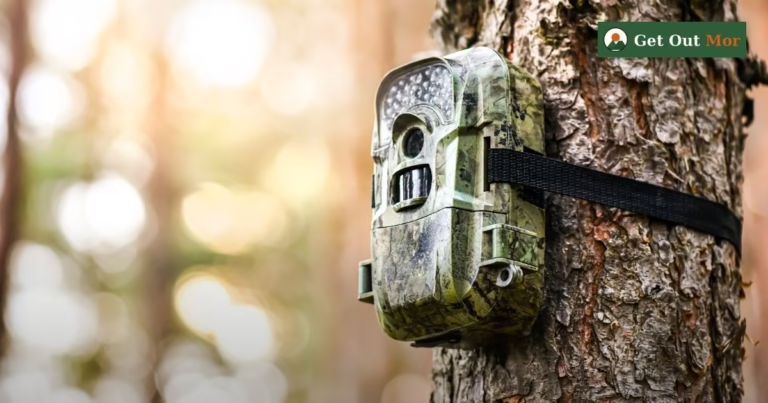
You can track your local deer patterns against weather data using quality trail cameras — pulling cards before and after fronts over a season will build a picture specific to your property that no study can give you.
Deer Movement Cold Front: A Quick Reference
| Conditions | Barometric Pressure | Expected Deer Activity |
|---|---|---|
| Stable weather, no system | 30.00–30.20 in. (steady) | Moderate — normal patterns |
| Front approaching, pressure dropping | 29.70–29.90 in. (falling) | High — pre-front feeding surge |
| Front actively passing | Below 29.70 in. (rapid drop) | Low — deer pushed into heavy cover |
| Post-front, pressure rising | 29.90–30.10 in. (rising) | High to Peak — best hunting window |
| Post-front, pressure stabilized | 30.10–30.30 in. (stable high) | Peak — prime conditions, especially with temp drop |
| Extended stable high pressure | Above 30.30 in. | Moderate declining — nocturnal patterns return |
Cold Front Timing and the Rut: The Multiplier Effect
A cold front during the rut doesn’t just help — it multiplies.
In the South, peak rut typically runs mid-October through mid-November, varying by latitude and subspecies. When a cold front rolls through during that window, you get two major biological triggers stacking on top of each other: the pressure-driven pre-front feeding surge plus the hormonal intensity of breeding season. Bucks that are already covering ground looking for does get pushed into overdrive.
The combination hunters talk about in near-mythical terms — a cold front coinciding with a full or new moon near peak rut — isn’t just folklore. The logic holds. Moon phases influence deer movement (though the science there remains debated), and a moon-front-rut convergence stacks every known movement trigger simultaneously.
If you see that combination on the horizon, call in sick. You need to be in the woods.
For more on how weather conditions interact with overall deer behavior, see our deep-dive on deer movement and weather research.
Reading the Forecast: What to Actually Watch
Most hunters check the temperature and wind. Start checking these instead:
Barometric pressure trend: More important than the absolute number is the direction and rate of change. A pressure reading of 29.85 and dropping fast is a better hunting indicator than 30.10 and holding flat.
Pressure rate of change: A drop of 4–5 tenths of an inch qualifies as a “rapid drop” by Keith Thomas’s research standards. That’s the threshold that correlates with peak movement activity.
Post-front timeline: The sweet spot is typically 12–18 hours after a front clears. Not immediately — the pressure is still rising and conditions may still be unsettled. Day 1 post-front is almost always better than the day of passage.
Wind direction shift: Cold fronts characteristically bring a northwest wind shift behind them in the South. That northwest wind is cleaner than the southerly winds that often precede a front. Position yourself accordingly — deer will be bedding with the wind at their back and eyes covering downwind approaches.
Cold Front Deer Movement: Timing Diagram
The chart below maps typical deer activity levels across a five-day cold front cycle. Day 0 is front passage.
What This Means for Your Hunt Plan
Knowing the science is one thing. Translating it into stand decisions is another.
Before a front: Hunt food sources and transition edges. Deer are feeding hard. Evening hunts shine here — deer are moving to food before dark. Morning hunts can be slower because deer may feed overnight and be back in their beds by first light.
During a front: Stay home or scout from the truck. Unless you’re in a stationary blind with a good rain setup and the wind is right, you’re probably burning a stand location for marginal odds.
After a front: Hunt all day if the rut is on. Post-front Day 1 is the most likely scenario for seeing a mature buck on his feet in daylight. Morning is your best bet, but mid-morning through noon can be surprisingly active on Day 1 post-front during the rut. Pack a lunch and stay put.
Wind: Northwest winds behind a cold front can be challenging in Southern terrain. Plan your approach and exit so you’re not walking through bedding areas. Deer that have been hunkered down are on high alert when they start moving again — a busted stand post-front stings more than normal.
Frequently Asked Questions
Do deer move more before or after a cold front?
Both windows produce elevated movement — but for different reasons. The pre-front window (24–48 hours before passage) produces a feeding surge driven by falling barometric pressure. The post-front window (12–24 hours after clearing) produces what many experienced hunters consider the highest-quality daytime movement, particularly when temperatures drop into the deer’s comfort zone and pressure rises back into the 29.90–30.30 inch range. During the rut, post-front Day 1 is generally the more productive window for mature bucks.
What barometric pressure is best for deer movement?
According to research by Illinois biologist Keith Thomas, deer move best when pressure sits between 29.90 and 30.30 inches of mercury, with peak activity at the higher end of that range (30.10–30.30 inches). Equally important is the rate of change — a rapid drop of 4–5 tenths of an inch is associated with the greatest burst of movement activity. Most hunting weather apps now display barometric pressure and trend arrows, making it easy to track.
Do deer move during a cold front or only before and after?
Movement drops significantly during actual front passage. High winds, precipitation, and rapidly shifting conditions push deer into heavy cover. Penn State’s GPS-collar research found no measurable difference in total daily distance traveled across front phases, but that data doesn’t distinguish between nocturnal and daytime movement — which is what matters for hunters. Field evidence consistently shows reduced accessible daytime movement during the worst of a front’s passage.
How much does temperature affect deer movement?
Temperature matters, but it’s secondary to barometric pressure changes. Mississippi State University research found minimal evidence that temperature alone drives movement. What matters more is the change in temperature relative to recent averages. A drop of 10–15°F from the recent baseline can trigger increased daytime movement in Southern deer. Temperature becomes most significant when it interacts with rising post-front barometric pressure.
Does a cold front help or hurt deer hunting during the rut?
It amplifies it significantly. A cold front during peak rut stacks two of the strongest movement triggers in the whitetail calendar simultaneously. Bucks are already covering ground looking for does; add pre-front feeding pressure or post-front crisp conditions and you have some of the best hunting days of the season. The combination of a cold front coinciding with a new or full moon during peak rut is considered a “red letter” opportunity by experienced hunters.
How long after a cold front should I hunt?
Day 1 post-front is your best window. Movement typically picks up 12–18 hours after the front clears. Day 2 post-front can still be productive, especially during the rut, but activity levels generally trend back toward moderate by Day 3 as conditions stabilize and deer settle into new patterns. Don’t wait too long — the post-front surge is a finite window.
Should I hunt in the rain before a cold front?
Light, steady rain before a front can actually be productive because deer are still feeding aggressively despite the precipitation — pressure has already started dropping and the urge to eat outweighs minor discomfort. Heavy rain or wind accompanying the front itself is a different story. If you’re hunting pre-front rain, focus on areas close to food that offer some canopy cover, and make sure you have a solid wind read before committing to a stand.