Best Deer Calls & Rattling Gear for the 2026 Rut
The grunt tube, doe bleat, rattling setup and decoy worth carrying into the 2026 rut, and when each one actually works.
Get Out Mor is reader-supported. When you buy through links on this page we may earn a small commission at no extra cost to you. As an Amazon Associate I earn from qualifying purchases. See our full disclosure.
Quick answer: most whitetail hunters need three things for the rut: a grunt call, a doe bleat and something to rattle with. The Illusion Systems Extinguisher (about $33) is the grunt tube to buy if you want one call that does grunts, bleats and snort-wheezes. On a budget, the Primos Trophy Grunter (about $12) and Primos The Original Can (about $13) cover grunts and estrus bleats for under $25 together. For rattling, the Knight & Hale Pack Rack (about $18) is the quiet, packable choice, and Flextone Battle Bones (about $25) sound more like real antlers. If you hunt field edges or food plots where bucks can see a long way, the Flambeau Boss Buck decoy (about $180) is the one big-ticket item that can pull a buck the last 100 yards.
These picks are research-based: built from manufacturer specs, current Amazon listings and patterns in owner reviews, not from field testing by Get Out Mor. Prices were checked on Amazon in October 2026. Before you hunt, confirm your season dates on our 2026 deer season dates by state page.
Not sure when the rut peaks where you hunt? See our deer rut dates by state, built from each state wildlife agency’s breeding-date map, and time your calling for the two weeks before the peak.
The picks at a glance
| Call or decoy | Type | Sounds / features | Best rut phase | Amazon rating | Price (Oct 2026) |
|---|---|---|---|---|---|
| Illusion Systems Extinguisher | Grunt tube | Adjustable 10-in-1: buck, doe and fawn; freeze-resistant reed | All phases | 4.6 (11,700+) | about $33 |
| Primos Trophy Grunter | Grunt tube | 6-in-1 adjustable reed, expandable hose | Pre-rut, seeking | 4.5 (1,300+) | about $12 |
| Primos The Original Can | Bleat can | Estrus doe bleat, grip rings | Seeking, chasing, breeding | 4.4 (500+) | about $13 |
| Knight & Hale Pack Rack | Rattle system | Interlocking rattle sticks, quiet when stowed | Pre-rut, seeking | 4.7 (430+) | about $18 |
| Flextone Battle Bones | Rattling antlers | Two bone-core synthetic racks, stack for carrying | Pre-rut, seeking | 4.6 (170+) | about $25 |
| Flambeau Boss Buck | Buck decoy | Full-size HDPE buck, 8-point antlers, removable legs, 20.3 lb | Seeking, chasing | 4.5 (830+) | about $180 |
Where the money goes
Calls are cheap; decoys are not. The chart shows the October 2026 Amazon price of every pick. The five calls together cost about $101, a little over half the price of the decoy. That is why we treat the decoy as an add-on for hunters who sit open terrain, not as part of a starter kit.
Which call works in which phase of the rut
The rut is not one event. Bucks behave differently over roughly six weeks, and the calls that work change with them. Exact timing varies a lot by region; in parts of the Deep South the breeding peak comes in December or January, weeks after the Midwest.
- Pre-rut (scrapes and rubs appear): bucks are sparring and establishing dominance. Soft grunts and light, short rattling sequences that sound like sparring work best.
- Seeking and chasing: bucks are covering ground looking for the first does in estrus. This is the best window for aggressive rattling, tending grunts, estrus bleats and a decoy.
- Breeding (lockdown): mature bucks are tied up with does and hard to pull away. A bleat can sometimes bring in a buck between does; rattling usually draws only young bucks.
- Post-rut: some does that were not bred come back into estrus about four weeks later. Bleats and soft grunts work again, especially on cold mornings.
The best rut calls and rattling gear, pick by pick
Best grunt call: Illusion Systems Extinguisher

The Extinguisher has more owner ratings than any other call here, more than 11,700 at 4.6 stars, and it is popular for a practical reason. Its ModiSlide reed adjusts in one motion between buck grunts, doe grunts and bleats, and fawn bleats, so one tube replaces several calls in your pocket. The slide also breaks a frozen or wet reed loose, which matters on the cold mornings when the rut is best. Illusion says each call is assembled and tuned in the USA.
Skip it if you only want a basic grunt and already carry a bleat can; the Primos Trophy Grunter does the core job for about a third of the price. Check price on Amazon →
Best budget grunt call: Primos Trophy Grunter
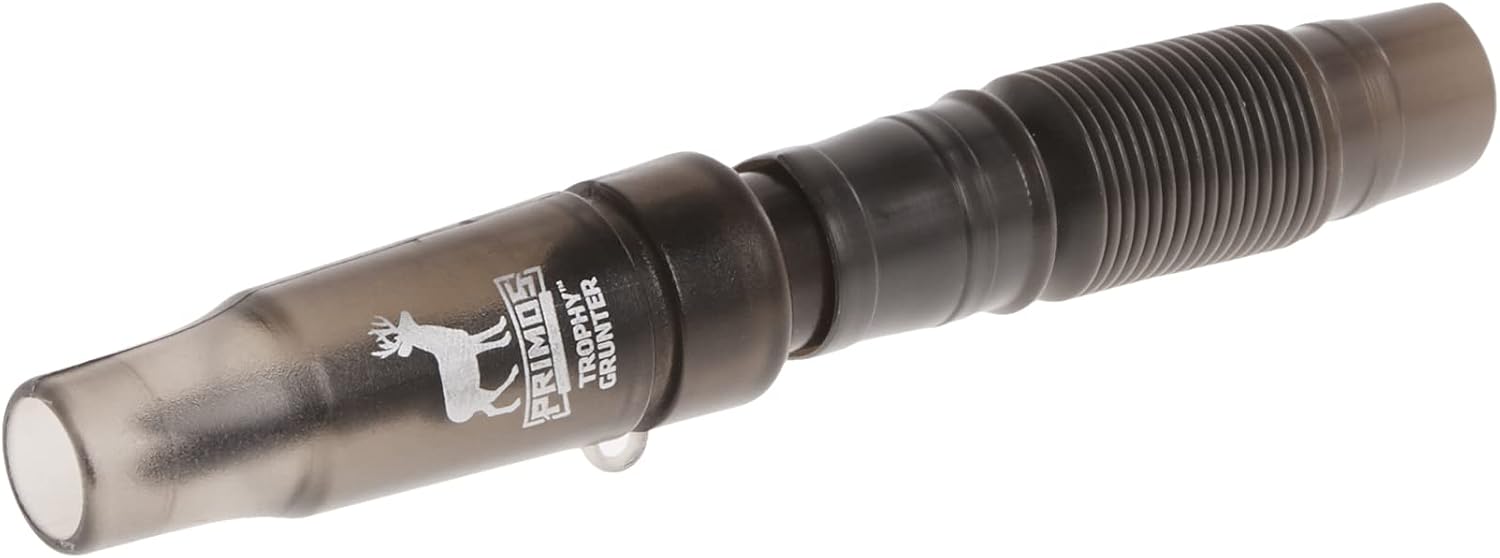
The Trophy Grunter is a long-running Primos design with an adjustable 6-in-1 reed and an expandable hose. Pulling the hose out lowers the tone toward a deep, mature-buck grunt; pushing it in gives a higher, younger sound. It is loud enough for windy days but can also be blown softly for close calling. It has 4.5 stars from more than 1,300 Amazon ratings.
Skip it if you hunt in very cold weather a lot; reeds without a freeze-resistant design can stick when your breath condenses inside the tube. Check price on Amazon →
Best doe bleat: Primos The Original Can

A bleat can is the simplest call in the woods: turn it over and it makes an estrus doe bleat. There is nothing to blow, so you can call with almost no movement, and you cannot sound wrong. Primos’ Original Can has a raised thumb-hole locator for a consistent seal and grip rings for cold or gloved hands. It has 4.4 stars from more than 500 ratings.
Skip it if you already carry an adjustable grunt tube that does bleats, like the Extinguisher; a can is still easier to use in the stand, but it is a duplicate sound. Check price on Amazon →
Best rattle bag: Knight & Hale Pack Rack

The Pack Rack is a set of interlocking hardwood rattle sticks that you roll and grind between your hands to make the clash of two bucks. It is louder than most rattle bags, packs small, and connects together so it stays quiet in your pack until you need it. It is the highest-rated item in this guide at 4.7 stars from more than 430 ratings.
Skip it if you want the most realistic tone; real or synthetic antlers like the Battle Bones sound closer to an actual fight. Check price on Amazon →
Best rattling antlers: Flextone Battle Bones

Battle Bones are two synthetic racks with a bone core, designed so you can clash both sides of both racks together the way two fighting bucks do, rather than tapping single tines. The grips are offset so your hands stay out of the way, the color is a non-reflective brown, and the two racks stack together to fit in a pack. They have 4.6 stars from more than 170 ratings.
Skip it if you hunt from a tight tree stand where swinging full racks is awkward; the Pack Rack is easier to work with small movements. Check price on Amazon →
Best decoy for open terrain: Flambeau Boss Buck

A decoy gives a buck something to see when he comes to your calling, which is often the difference between a buck hanging up at 120 yards and walking into range. The Boss Buck is a full-size, blow-molded HDPE mature buck in a natural posture. It comes with an 8-point set of plastic antlers and a blaze orange carry sling, and its legs come off and store inside the body for transport. It weighs about 20 pounds and has 4.5 stars from more than 830 ratings.
Use it where a buck can see it from a distance: field edges, food plots, cut corn and open pine flats. Set it 15 to 25 yards from your stand, quartering toward you, because bucks usually circle to face a rival decoy. Always carry it with the orange sling or covered in blaze orange, and check your state’s regulations and the rules for the land you hunt before you set one out.
Skip it if you hunt thick woods where deer cannot see more than 40 yards; calls alone are enough there, and a 20-pound decoy is hard to carry in. Check price on Amazon →
How to call and rattle during the rut
Start soft
Most calling mistakes are about volume and frequency. Start with two or three soft grunts or a single bleat, then wait 15 to 20 minutes before calling again. A buck that is already nearby may come in silently, so be ready before you call.
Rattle in sequences
A typical rattling sequence is 30 to 60 seconds of clashing and grinding, followed by 10 to 20 minutes of watching. Start quietly in the pre-rut, like sparring, and get louder during the seeking phase. Grunting during and after the sequence makes it sound more like a real fight.
Play the wind
A buck answering a call almost always tries to circle downwind to smell what he heard. Set up so that the downwind side is open ground you can see or shoot across, or put a decoy where his approach will bring him past you.
Match your region’s timing
Rut timing differs widely across the South, from late October in the upper South to January in parts of Alabama and the Gulf Coast. Check your state wildlife agency’s rut or breeding-date data and pair it with your season dates.
Frequently asked questions
What is the best deer call for the rut?
A grunt call is the most useful single call. An adjustable tube like the Illusion Extinguisher also makes doe and fawn bleats, which covers most rut situations in one call.
Does rattling work in the South?
Yes, but results vary with the buck-to-doe ratio. Rattling tends to work best where there are more mature bucks competing for fewer does, and during the seeking phase just before peak breeding.
How often should I use a bleat can?
A few bleats every 20 to 30 minutes is plenty. Overcalling makes deer suspicious, especially on pressured public land.
Are electronic deer calls legal?
It depends on the state, and many states prohibit electronic calls for deer. Check your state’s regulations before using one; the calls in this guide are all mouth-blown or manual.
How these picks were chosen
We did not field-test these calls for this article. The picks are based on manufacturer descriptions, the details and ratings on each Amazon listing, and recurring themes in owner reviews. We checked that each link opens the exact product named and checked prices on Amazon in October 2026. Our full process is at how we pick gear.