Public Land Deer Hunting Pressure: What the Science Says and How to Beat It
You already know it’s harder. You felt it the first time you pulled into a WMA parking lot at 4:30am and found six trucks already there. You’re not imagining it — public land deer hunting pressure is the real deal, it’s gotten measurably worse over the last five years, and it is not going away. The good news is that most hunters are still making the same amateur mistakes, and the research on how pressured deer actually behave gives you a legitimate edge if you’re willing to do the homework.
The Numbers Don’t Lie — Public Land Got Crowded
The 2020 COVID-19 pandemic didn’t just change how people worked and lived — it permanently changed who shows up in the woods.
When businesses shut down and gyms closed, the woods stayed open. Hunting license sales jumped 8% nationally according to the U.S. Fish and Wildlife Service, with some state-level analyses tracking increases closer to 12%. The National Shooting Sports Foundation (NSSF) documented a 20%-plus surge in new hunters in 2020 alone, including a 47% spike in new female hunters. Those aren’t flash-in-the-pan numbers — the five-year post-COVID baseline shows roughly 25% more active hunters than the pre-2020 average. By 2025, estimates put the U.S. hunting population at approximately 15.2 million people.
That’s a lot of orange hats chasing the same public acres.
Layer on the technology shift and the picture gets even more crowded. The onX Hunt app launched in 2012. By the mid-2020s it had millions of subscribers, and it put every parcel boundary, every public land acre, and every road access point on a screen in your back pocket. That’s genuinely great for access — it democratized information that used to take locals years to accumulate. But it also meant that formerly obscure WMA tracts and national forest pockets that used to see a handful of hunters a season are now showing up in YouTube videos and getting hammered on opening week.
More hunters. Better maps. More accessible public land intel. The same number of public land acres. The math is not in your favor, and pretending otherwise is just lying to yourself before the season starts.
What the Science Says About Pressured Deer
Here’s where it gets interesting — because researchers have actually GPS-collared bucks and tracked exactly what hunting pressure does to their behavior, and the findings should change how you approach every sit.
Under zero hunting pressure, whitetail deer are not particularly nocturnal animals. GPS collar studies show that unpressured deer naturally distribute their movement roughly 60% during crepuscular and nighttime hours, with about 40% during legal daylight shooting hours. They’re wired to move at dawn and dusk, yes, but a significant chunk of their activity happens when you can legally pull a trigger or release an arrow.
Introduce hunting pressure and that math flips fast. A study published in the Journal of Wildlife Management tracked 48 GPS-collared bucks through hunting season. During open season, mature bucks — 3.5 years and older — were moving during legal shooting hours only 15 to 22% of the time. That’s a dramatic behavioral shift, and it doesn’t take weeks to set in. The research found that the nocturnal adjustment happens within 48 hours of a season opener or a significant pressure event.
The Mississippi State University Deer Lab adds another layer that most hunters don’t think about. Their research categorized bucks by personality type: roughly 60% of bucks are “sedentary” — they maintain one contiguous home range year-round. The other 40% are “mobile” — they run two seasonal ranges that may be separated by several miles. When you’re hammering a piece of ground and not seeing anything, there’s a real chance you’re dealing with a homebody buck who hasn’t gone anywhere. He’s just gone invisible, packing his core area down from roughly a square mile to under 100 acres and doing almost all of his moving between midnight and 5am.
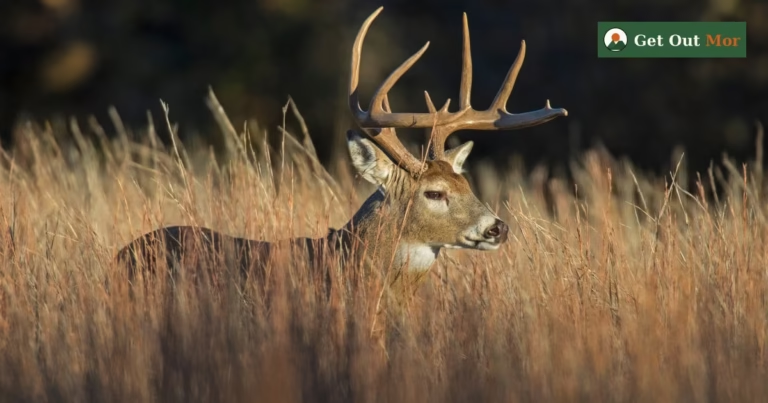
The critical insight from all of this: pressured deer don’t always leave. They just go nocturnal. The buck you bumped off that ridge on opening morning is probably bedded within 300 yards of where you jumped him. He’s still there. You just can’t see him anymore.
The Deer Didn’t Leave. They Just Went Invisible.
This is the hardest mental adjustment for hunters raised on the idea that bumped deer “blow out of the country.” On big private ranches with neighboring properties, that can be true. On a 50,000-acre national forest unit surrounded by more forest? That buck has nowhere meaningful to go. His home range is here. His food is here. His does are here.
What changes is the when. Parallel research on sika deer — a close behavioral cousin to whitetails in terms of pressure response — found that deer subjected to hunting pressure can maintain altered, almost entirely nocturnal activity patterns throughout the entire year, not just during open season. The behavioral memory of pressure persists.
This matters tactically because it tells you two things. First, scouting bumps count. Every time you walk into a spot — even to check a camera or confirm sign — you’re burning the clock on that deer’s wariness. Second, recovery is real. Research consistently shows that deer return toward normal daylight activity within a couple of days of hunters leaving an area entirely. Let pressure drop and the deer show back up in daylight. This is why mid-week hunting is not just a scheduling convenience — it’s a legitimate tactical edge.
Deer Activity: Before vs. After 48–72 Hours of Hunting Pressure
The diagram below shows how dramatically deer daytime movement collapses once hunting pressure hits. This isn’t anecdotal — it’s what the GPS collar data looks like.
Source: Journal of Wildlife Management GPS collar study, 48 bucks tracked through hunting season. Mature bucks (3.5+ years) reduced legal-hour movement to 15–22% of baseline within 48 hours of pressure.
Pressure Level Quick Reference
| Pressure Level | What’s Happening | Expected Deer Behavior | Your Adaptation |
|---|---|---|---|
| Low | Few hunters, mid-week or early-season | Natural crepuscular movement, 35–40% daylight activity | Standard dawn/dusk sits; focus on food-to-bed transitions |
| Moderate | Weekend pressure, 2–4 hunters per 1,000 acres | Daytime movement shifts earlier and later; bucks more cautious | Hunt the fringes of legal light; obsess over wind |
| High | Heavy opener pressure; crowded WMAs | Mature bucks drop to 15–22% daylight movement within 48 hrs; core areas contract | Hunt mid-week; go deeper; find escape cover and travel corridors |
| Extreme | Sustained multi-week pressure, popular public tracts | Near-total nocturnal shift; deer bed in nastiest available cover; pressure memory can persist year-round | All-day sits in unpressured micro-areas; “pressure map” escape route strategy; consider a different unit |
The Tactics That Still Work in 2026
This is where we stop talking about the problem and start fixing it. None of this is magic. It’s disciplined execution of fundamentals that most hunters skip because they’re inconvenient.
Wind Discipline Is Non-Negotiable
This is the single biggest separator between hunters who kill public land bucks and hunters who don’t. Most public land hunters pick a stand, look at the weather app for the general wind direction, and head in. That’s not good enough.
You need to know the prevailing wind direction, the thermal behavior at your specific location at your specific entry time, and whether your stand is positioned to keep your scent stream off the travel corridor you’re hunting. If the wind isn’t right for a specific stand, you don’t hunt that stand. Period. The cost of burning a spot with your scent is far greater than the cost of going home.
Carry a quality wind checker — powder or milkweed — and use it every time you move. Don’t trust your phone’s weather app for thermals near water, in hollows, or on hillsides. Those micro-variations will burn you consistently.
Plan Your Entry AND Your Exit
Most hunters plan how to get to their stand. The good ones plan how to get out without blowing every deer off their feed.
Cross deer trails at 90 degrees when you have to cross them at all. Use waterways, ditches, creek beds, and terrain breaks as natural scent corridors — the water carries your odor away instead of letting it pool on a trail. More importantly, know your exit before you sit down. If deer are feeding in the field at last light and you have to walk through them to get to your truck, you’re not just ruining tonight — you’re making tomorrow harder too.
Go Where Other Hunters Won’t
The research is unambiguous: even on hammered public land, you can find pockets of low pressure if you’re willing to earn them. Beaver dams require waders. Steep ridges require lungs. Chest-deep creek crossings require commitment. These are your best friends on public land because the average weekend warrior stops at the first comfortable walk-in distance from the road.
A consistent rule of thumb from experienced public land hunters: get beyond one mile from the nearest road, trailhead, or marked trail and you’ve already left most of the competition behind. Mapping apps make this easier than ever — identify the furthest accessible points from any road, find water crossings or steep terrain that serves as natural barriers, and work those areas hard.
Saddles in ridgelines are a particularly underrated feature. They’re travel corridors that deer use reliably even under heavy pressure — the terrain funnels them through whether they want to or not. Find the saddle nobody else is hunting and you’ve found your spot.
Hunt Mid-Week When You Can
Tuesday and Wednesday are different hunts than Saturday and Sunday. Most hunters are weekend warriors with jobs and family obligations. The pressure that made that buck go nocturnal over the weekend lifts by Tuesday morning. Deer that were bedded hard for 72 hours start moving again. The research confirms this — recovery toward normal daylight movement begins within a couple of days of reduced human presence.
If you have any flexibility in your work schedule, treat mid-week morning sits as your highest-priority hunts during November. You are functionally hunting a different, less-pressured deer than the guy who can only go on weekends.
The Saddle Hunting Advantage
The biggest tactical shift in public land bowhunting in the last decade isn’t a new broadhead or a better call. It’s mobile hunting systems — specifically saddle setups paired with climbing sticks or aiders. A saddle hunter can set up in virtually any tree, at any height, facing any direction, in under 20 minutes. This matters enormously on public land because it means you’re not limited to trees with existing steps or ladder stands — you can climb the mid-slope oak that overlooks a ridge saddle with a perfect wind that nobody else is hunting because nobody else can get into that tree.
Check out the best deer hunting gear for 2026 for a breakdown of the current top saddle setups, climbing sticks, and wind-checking tools worth putting money into.
The “Pressure Map” Strategy
This one requires some observation and legwork, but it pays off. Before you hunt, identify where other hunters are parking, where they’re entering, and what areas they’re hitting. You can often figure this out from tire tracks, worn trails, boot prints, and the location of obvious stands and hang-ons visible from the road.
Now set up downwind of those areas, along what the terrain suggests are escape routes. When those hunters bump deer — and they will, especially on opening weekend — pressured deer move predictably. They go into the wind, toward thicker cover, often through saddles and drainages. If you’ve identified those escape corridors and you’re sitting in them with a clean wind, you’re hunting deer that another hunter pushed right to you.
The Pressure Actually Works For You (If You’re Smarter Than the Average Hunter)
Here’s the counterintuitive part: the crowding that’s making public land harder is also, if you do your homework, making it more predictable.
Pressured deer are conditioned deer. They have consistent behavioral patterns. They bed in specific types of cover. They use specific escape routes. They respond to pressure in measurable, studied ways. The research on their behavior under hunting pressure gives you a playbook that most of the hunters competing with you have never read.
Most public land hunters are hunting by feel — they go to spots that look good on a map, they go when they can, they hunt the same old stands year after year, and they wonder why they’re not seeing mature bucks. They’re not obsessing over entry routes. They’re not running cameras to identify unpressured micro-areas. They’re not hunting mid-week. They’re not thinking about escape corridors.
If you’re doing those things — if you’re treating public land like a chess game instead of a shooting gallery — you are effectively hunting in a different category than most of the competition. The herd is the same. The acres are the same. But the strategy is completely different.
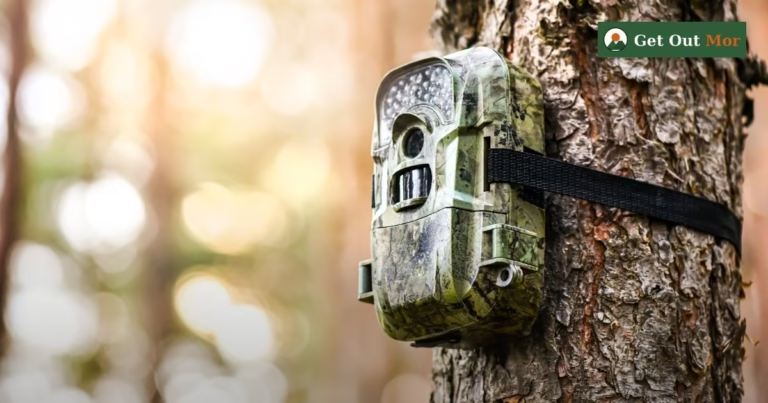
Trail cameras positioned at the edges of high-pressure areas, monitoring travel from thick bedding cover toward food sources, can help you identify where deer are actually moving under pressure. See the best trail cameras for 2026 for current options that won’t break the bank and won’t tip off other hunters to your setup.
Setting Realistic Expectations
This is the part nobody wants to hear, so let’s get it out of the way.
Public land deer hunting is a grind. On well-pressured WMAs and national forest units in the South, killing a mature buck — a 3.5-year-old or older — might take 12 to 20 sits of quality, disciplined hunting. That’s not a failure. That’s public land. A legitimate public land buck after 15 sits is a trophy by any reasonable standard, full stop.
The hunters who struggle are the ones who show up with private land expectations. They want daylight buck movement on day one. They want a shooter in front of them by the third sit. When that doesn’t happen, they decide the deer aren’t there and move on — bumping everything in the process.
Calibrate your expectations to match the reality of the resource you’re hunting. Be disciplined, be patient, do the legwork, and stack the science in your favor. The bucks are there. They’re just watching you from 40 yards in thick cover, waiting for you to make a mistake.
Frequently Asked Questions
Q: Does hunting pressure actually make deer move to different areas, or do they just go nocturnal?
A: Mostly the latter, especially on large contiguous public land blocks. The Mississippi State Deer Lab found that roughly 60% of bucks have a “sedentary” personality — one continuous home range they don’t abandon under pressure. They contract their core area and shift to near-total nocturnal movement rather than relocating. Some mobile bucks (about 40%) do maintain two seasonal ranges, but even those usually stay within the same general landscape. Assume the deer is still there.
Q: How long does it take pressured deer to return to normal daytime movement?
A: Research consistently shows that deer begin returning toward normal activity patterns within 48 to 72 hours of pressure being removed. This is why mid-week hunting is so effective — the weekend pressure fades, and by Tuesday or Wednesday you’re hunting a measurably less-pressured deer.
Q: Is there any time of year when pressure matters less on public land?
A: The rut is your best window. Breeding behavior overrides a lot of the caution that pressured bucks maintain the rest of the year. A buck locked on a hot doe will move in daylight even under moderate pressure. November rut hunting on public land — especially mid-week during peak breeding — gives you a real shot at catching a mature buck on his feet during legal hours.
Q: What’s the best way to find unpressured micro-areas on public land?
A: Start with mapping apps — identify terrain features (steep draws, water crossings, thick bedding cover) that serve as natural barriers to casual hunters. Then deploy a trail camera to confirm whether deer are actually using that area, and whether daytime photos exist. Daytime photos in a specific spot are a strong indicator that pressure there is low. See our best trail cameras for 2026 for the gear to do this efficiently.
Q: Is it worth hunting the same pressured spot multiple times in a row?
A: Generally no. Every time you enter a stand location, you reset the pressure clock for that micro-area. On public land, rotating between two or three setups — hunting each no more than once every three to four days — gives deer time to settle and improves your odds of a daylight encounter significantly.
Q: Does scent control actually matter on pressured public land?
A: Yes, but wind discipline matters more than any spray or suit. No scent control system fully eliminates human odor. What it does is reduce your margin of error slightly. Playing the wind correctly eliminates the problem at the source. Obsess over wind first, then use scent control as a secondary layer — not the other way around.
Q: Are saddle hunting setups worth the learning curve for a weekend public land hunter?
A: For mobile public land hunting, yes — the ability to climb any tree and set up quickly with a perfect wind is a genuine advantage that no fixed-position system can replicate. The learning curve is real but manageable. Most hunters are comfortable with a saddle setup within a few practice sessions. The best deer hunting gear for 2026 includes saddle system recommendations at different price points.