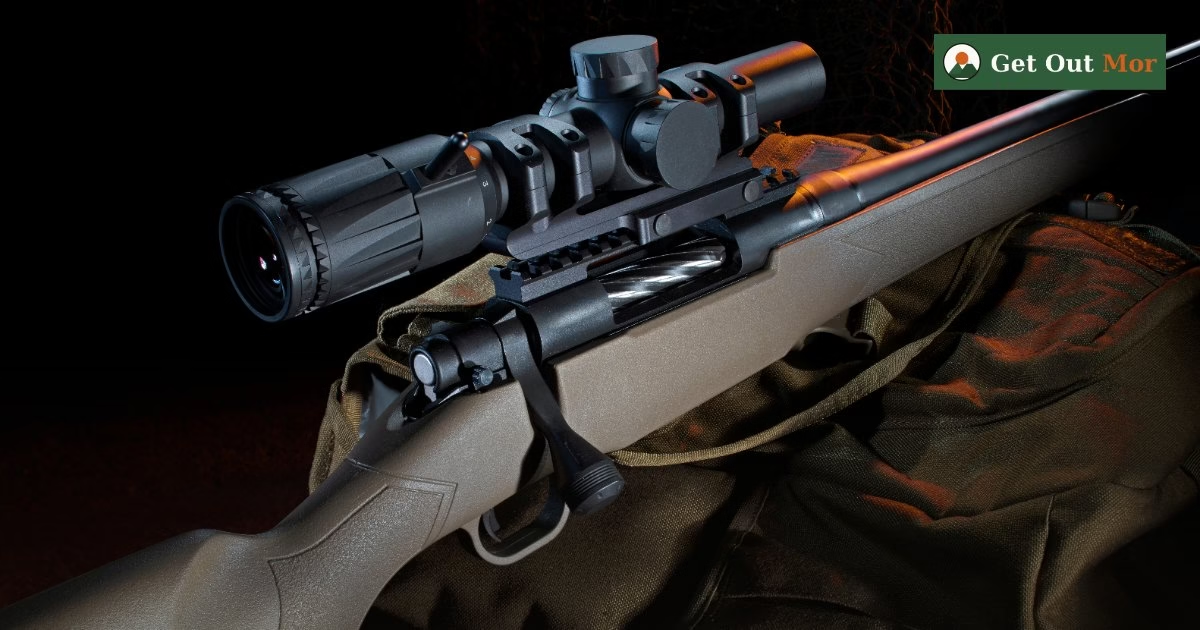
Comparing the Top Calibers for Whitetail Deer Hunting
The best rifle calibers for whitetail deer — how the top choices compare on power, recoil, range, and ammo availability.
Looking for buying advice based on your specific hunting scenario instead? See our companion guide, Best Caliber for Whitetail Deer Hunting (2026 Guide), which walks through choosing a caliber by situation (public land, youth/recoil-sensitive shooters, thick brush vs. open fields, etc.). This page is the detailed side-by-side spec comparison.
Get Out Mor is reader-supported. We may earn a small commission from links on this page at no cost to you. As an Amazon Associate I earn from qualifying purchases. See our disclosure.
👤 Who This Is For
Deer hunters — from first-season beginners to experienced hunters switching rifles — who want a straight answer on which caliber fits their hunting style, budget, and terrain. Especially useful for hunters in the South where shot distances and deer size differ from the Midwest and West.
⚡ Bottom Line
Best all-around choice: The .30-06 Springfield or .308 Winchester handle virtually every whitetail situation and ammunition is everywhere.
Best for Southern hunters and youth: The .243 Winchester — lighter recoil, lower cost, and perfectly suited for the smaller whitetails common in the South.
Best for long-range open country: The 6.5 Creedmoor or .270 Winchester — both shoot flat and are increasingly easy to find on shelves.
Choosing the right caliber for whitetail deer hunting is one of the most debated topics in the deer camp. Get it wrong and you’re dealing with wounded deer, excessive recoil, or ammo you can’t find when season opens. Get it right and the rifle disappears — all you’re thinking about is the shot.
I’ve hunted whitetails in the South for over 30 years, primarily with a .30-06 Springfield, and have taken deer and elk with several of the calibers on this list. This comparison covers the seven most practical whitetail calibers based on real field performance, not just ballistics charts.
Gear that goes with your caliber
Once you’ve settled the cartridge, the rest of the rig decides whether the shot lands: our tested rifle scopes under $500, a bipod or rest for steady field shots, and quality ammo you’ve actually zeroed with.
rifle scopes →bipods →ammo →rests →ear protection →As an Amazon Associate, we earn from qualifying purchases.
Quick Comparison: Top Whitetail Calibers
| Caliber | Best For | Recoil | Ammo Cost | Availability |
|---|---|---|---|---|
| .30-06 Springfield | All-around, any terrain | Moderate | $$ | Excellent |
| .308 Winchester | Mid-range, versatile | Moderate | $$ | Excellent |
| .270 Winchester | Long-range, open country | Moderate | $$ | Good |
| 7mm Rem Mag | Long-range, larger game | Heavy | $$$ | Fair |
| .243 Winchester | Youth, Southern whitetails | Light | $ | Excellent |
| 6.5 Creedmoor | Medium-long range, accuracy | Light-Moderate | $$ | Good |
| .30-30 Winchester | Brush hunting, short range | Moderate | $$ | Good |
Approximate recoil energy (ft-lb) in a typical 8-lb rifle with common factory loads. For most deer hunters, manageable recoil means better shot placement — which matters more than raw power. Estimates only; actual recoil varies by load and rifle weight.
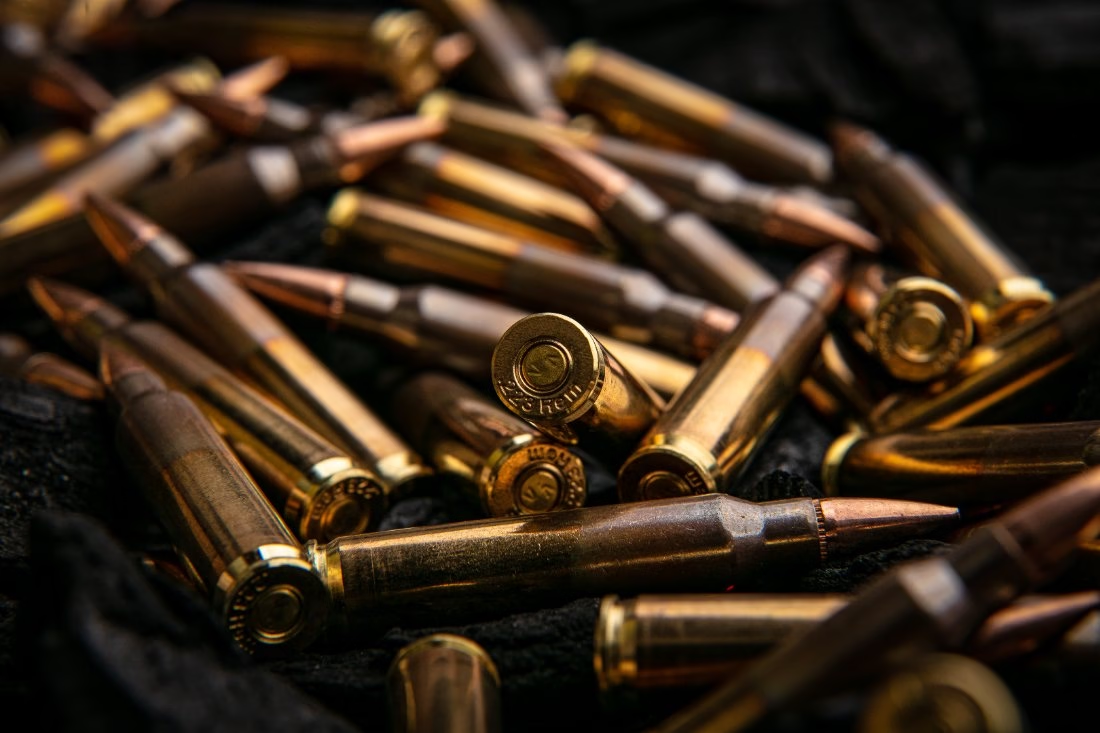
1. .30-06 Springfield
Velocity
2,800–3,000 fps depending on load and barrel length.
Trajectory
~8 inch drop at 300 yards zeroed at 200. Manageable for most whitetail shots.
Bullet Weight
150–180 grains. Wide selection of loads for different game and ranges.
Availability
Found in virtually every sporting goods store and Walmart in the country.
The .30-06 has been my primary deer rifle for 30 years. I’ve taken whitetails with it from Alabama swamps to open fields, and used it on elk out West without changing anything but the load. It’s not the flattest-shooting round on this list, but it handles every realistic whitetail scenario without complaint. If you’re buying one deer rifle and want to stop thinking about caliber selection forever, this is it.
2. .308 Winchester
The .308 Winchester delivers nearly identical performance to the .30-06 in a slightly shorter cartridge. Recoil and trajectory are comparable, ammo is everywhere, and the shorter action makes for a slightly lighter rifle. Used widely by military and law enforcement, which means supply is consistent and prices are reasonable. A reliable workhorse for any whitetail environment.
3. .270 Winchester
The .270 Winchester shoots flatter than the .30-06 with only about 6 inches of drop at 300 yards, making it a favorite for Western-style hunting with longer shot opportunities. It handles any whitetail cleanly and ammunition has remained consistently available. If your hunting involves large food plots, open fields, or powerline shots where distance is a factor, the .270 earns its reputation.
4. 7mm Remington Magnum
The 7mm Rem Mag delivers serious reach and energy, making it more rifle than most whitetail situations require. It shines when you’re hunting country where 400+ yard shots are realistic, or when whitetail season is part of a broader western hunt. The tradeoff is recoil and ammo availability — I’ve had trouble finding it post-pandemic, and it costs noticeably more per box than the standard calibers above.
5. .243 Winchester
The .243 Winchester is the round I recommend first to new hunters and anyone putting a young hunter in the field. Recoil is genuinely mild, ammo costs less than the .30-06 or .308, and it’s widely available. For Southern whitetails — which run smaller than their Northern and Midwestern counterparts — the .243 is more than adequate. It’s also a popular varmint round, so supply stays strong year-round.
6. 6.5 Creedmoor
The 6.5 Creedmoor has earned its popularity quickly. It shoots flat, bucks wind well, and produces less recoil than the .30-06 or .308 while delivering comparable terminal performance on deer-sized game. It also proved its worth during pandemic-era ammo shortages — when .30-06 and .308 disappeared from shelves, 6.5 Creedmoor stayed available longer. Availability has normalized since, and it’s now stocked in most sporting goods stores.
7. .30-30 Winchester
The .30-30 Winchester is the classic brush gun, and it earns that title. In thick Southern swamps filled with palmettos and dense pine, where shots rarely exceed 100 yards, the .30-30 in a lever-action rifle is a practical and historically proven choice. It’s not a long-range round — drop becomes significant past 200 yards — but for the hunting environments where it shines, nothing beats the handling of a light lever-action carbine in .30-30.
Top 3 Calibers: Pros and Cons
✅ .30-06 Springfield Pros
- Handles any whitetail situation
- Ammo available everywhere
- Wide range of loads and bullet weights
- Proven on larger game too
❌ .30-06 Springfield Cons
- More recoil than .243 or 6.5 Creedmoor
- Overkill for close-range brush hunting
- Heavier rifles compared to shorter cartridges
✅ .243 Winchester Pros
- Lightest recoil on the list
- Most affordable ammo
- Ideal for youth and new hunters
- Perfect for Southern whitetails
❌ .243 Winchester Cons
- Marginal on larger deer species
- Not ideal for elk or larger game
- Less effective at extreme ranges
✅ 6.5 Creedmoor Pros
- Excellent long-range accuracy
- Manageable recoil
- Improved availability post-pandemic
- Flat trajectory
❌ 6.5 Creedmoor Cons
- Newer — less legacy support in rural stores
- Slightly more expensive than .308
- Not ideal for brush hunting
Which Caliber Should You Choose?
Choose .30-06 or .308 if…
- You want one rifle for all deer hunting situations
- You hunt mixed terrain — woods and open fields
- You may also hunt elk or larger game
- Ammo availability is a priority
Choose .243 if…
- You’re putting a youth or new hunter in the field
- You hunt Southern whitetails at typical ranges
- Recoil sensitivity is a factor
- Budget is a priority
Choose 6.5 Creedmoor if…
- You take longer shots in open country
- You want modern ballistics with less recoil
- Precision shooting matters to you
- You’re comfortable with a newer cartridge
📋 Key Takeaways
- No wrong answer in the top three — the .30-06, .308, and .270 all cleanly take whitetails at any realistic range.
- Southern hunters can go lighter — the .243 is genuinely sufficient for the smaller whitetails common in Alabama, Georgia, and Mississippi.
- The 6.5 Creedmoor has earned its place — availability has improved and its ballistic performance is hard to argue with.
- The .30-30 still works — in thick cover at short range, a lever-action .30-30 is a legitimate and practical deer rifle.
- Check local ammo supply before deciding — the best caliber is the one you can actually find on shelves when season opens.
Best Caliber for Whitetail Deer Hunting: Quick Answers
What is the best caliber for whitetail deer hunting? For most hunters, the .308 Winchester and .30-06 Springfield are the best all-around calibers for whitetail deer — they carry enough energy well past 300 yards, ammo sits on every shelf, and recoil stays manageable. If you want a lighter-kicking option, the 6.5 Creedmoor and .243 Winchester are the best low-recoil choices, and the .30-30 Winchester is still a proven brush-country deer caliber.
What is the best caliber for a beginner deer hunter? The .243 Winchester and 6.5 Creedmoor. Both are flat-shooting with mild recoil and plenty of energy for whitetail inside 300 yards, so new hunters can focus on shot placement instead of flinch.
Is the 6.5 Creedmoor good for whitetail deer? Yes. The 6.5 Creedmoor is one of the best modern whitetail calibers — light recoil, excellent accuracy at range, and widely available ammo.
📚 Related Articles
Ready to Get Out There?
Browse all our deer hunting guides, gear reviews, and tactics.
Browse Deer Hunting Guides →Related Guides
- Best Caliber for Whitetail Deer Hunting (2026 Guide) — scenario-based buying advice
- Field Dressing Kit: What You Need
- How to Get Private Land Deer Hunting Access (2026)
- Do Deer Move in Cold Fronts? What the Science — and the Stand — Actually Tell You
- LaCrosse Alphaburly Pro Review: The Whitetail Hunter’s Rubber Boot
- Public Land Hunting Laws vs. Private Land: What Every Southern Hunter Needs to Know
- Best Trail Cameras for Deer Hunting (2026): Cellular vs. Non-Cellular
- Hunters Beware. The Growing Threat of CWD in the Southeast