How to Find and Catch Crappie: A Season-by-Season Guide
Crappie are the most beginner-friendly fish in freshwater — if you know the one thing that finds them: depth.
This guide links to gear we recommend. As an Amazon Associate we earn from qualifying purchases at no cost to you. Disclosure.
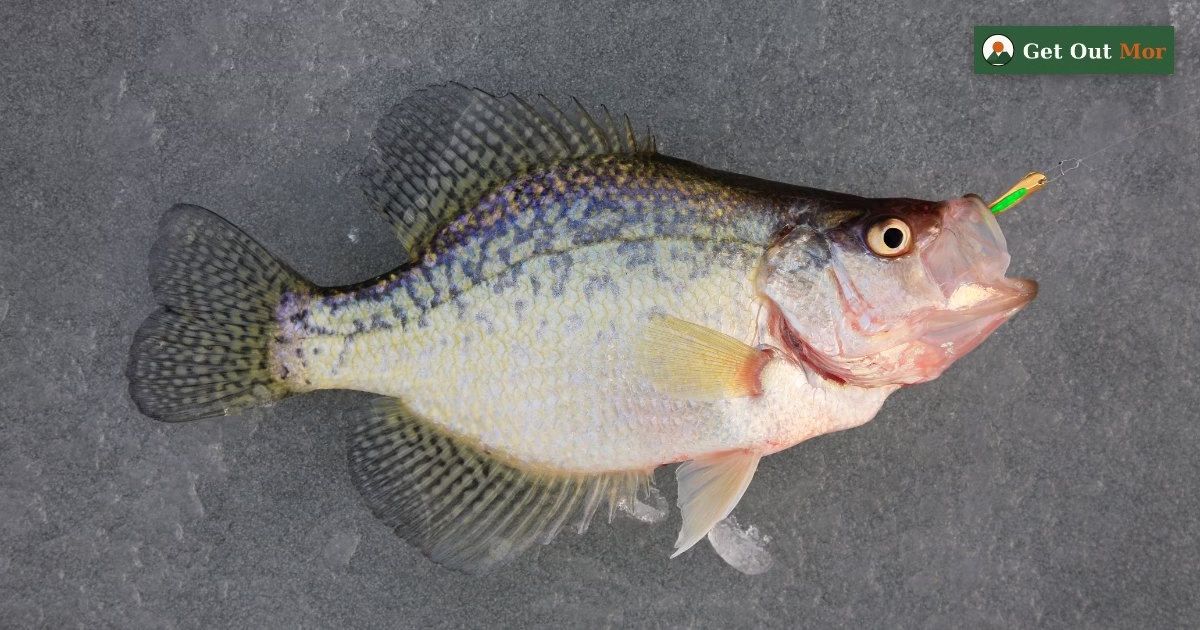
Crappie are abundant, delicious, and easy to catch once you find them — and finding them is almost entirely about depth and structure. They school tightly and hold at a specific depth layer that shifts with the season. Nail the depth and you’ll fill a cooler; miss it by a couple feet and you’ll swear the lake is empty. Here’s the season-by-season map.
Typical depth ranges where crappie school through the year (feet). Exact depth shifts with water clarity, structure, and forage — let your electronics confirm. The pattern, not the precise number, is what matters.
Where crappie live
Crappie relate to vertical structure: brush piles, submerged timber, dock pilings, bridge supports, and weed edges. They travel in schools, so the fishing is feast or famine — when you catch one, you’ve almost certainly found a crowd. Stay on that spot and that depth.
Spring (55–65°F): the best bite of the year
From roughly March through May, crappie move shallow to spawn and turn aggressive.
This is the ideal time for beginners and kids — the fish are shallow, hungry, and grouped up.
Summer (warm water): go deeper
This is where a basic fish finder earns its keep: find the suspended school, then drop a jig to their exact depth.
Fall (cooling water): shallow again
As temperatures fall through October and November, crappie follow baitfish back toward shallow and mid-depth brush, dock areas, and cove entrances — generally 5–12 feet, shallowing as it cools. A strong, often-overlooked bite.
Winter (cold water): deep and slow
Crappie hold on the deepest available structure — deep brush piles (15–25 ft), creek channel edges, and standing timber at depth. They bite, but slowly; downsize your jig and fish it dead-slow right in the school.
The 2-foot rule that finds them fast
Simple gear is all you need
A small jig, a tiny soft plastic, or a live minnow under a bobber will catch crappie in virtually every season and water type. You don’t need a tackle box full of specialty lures — you need to find the right depth. A light spinning setup is perfect.
Sources
Sources: Outdoor Life, Field & Stream, state DNR fishing guides (MN, NY), and Wired2Fish crappie guides.
FAQ
Spring, when water reaches 55–65°F and crappie move shallow to spawn. They’re grouped up, aggressive, and in 2–6 feet of water — the easiest bite of the year.
It depends on season: 2–6 ft in spring, 10–25 ft in summer, 5–12 ft in fall, and 15–25 ft in winter. Within any season, they hold at a precise layer — adjust in 2-ft steps to find it.
A live minnow or a small jig under a bobber, set to the depth the fish are holding, near brush or docks. Simple gear plus the right depth beats fancy tackle every time.
The quick version
- Crappie school tightly — find one and you’ve found the crowd.
- Spring (55–65°F, 2–6 ft) is the easiest bite of the year.
- They go deep in summer (10–25 ft) and winter (15–25 ft).
- Adjust depth in 2-ft steps until you find the layer — it’s everything.
Gear We Recommend
Here is the gear that makes this easier, ready to shop. As an Amazon Associate, we earn from qualifying purchases.
- Fishing rod & reel — See combos
- Tackle — Shop tackle
- Braided line — Compare braid
- Pliers — See pliers
- Tackle box — Browse tackle boxes