How to Catch Bass in Every Season: A Water-Temperature Guide
Largemouth bass don’t read calendars — they read thermometers. Here’s where they are and how to catch them in every season, by the degree.
This guide links to gear we recommend. As an Amazon Associate we earn from qualifying purchases at no cost to you. Disclosure.
If you only learn one thing about bass fishing, make it this: water temperature drives almost everything a bass does — where it lives, what it eats, and how aggressively it bites. Learn to fish the thermometer instead of the calendar and you’ll catch bass all year. Here’s the season-by-season breakdown, with the exact temperatures that trigger each shift.
Bass don’t read calendars — they read thermometers. These are the general surface-temperature ranges that drive each phase of the year. Timing shifts with your latitude and the weather.
Why water temperature matters more than the date
Bass are cold-blooded, so their metabolism rises and falls with the water. Cold water slows them down and pushes them deep; warming water speeds them up and pulls them shallow. A 55°F lake in Georgia and a 55°F lake in Michigan will fish almost identically — even if one is in February and the other in May. Buy a cheap clip-on or electronic water thermometer; it’s the most useful tool in the boat.
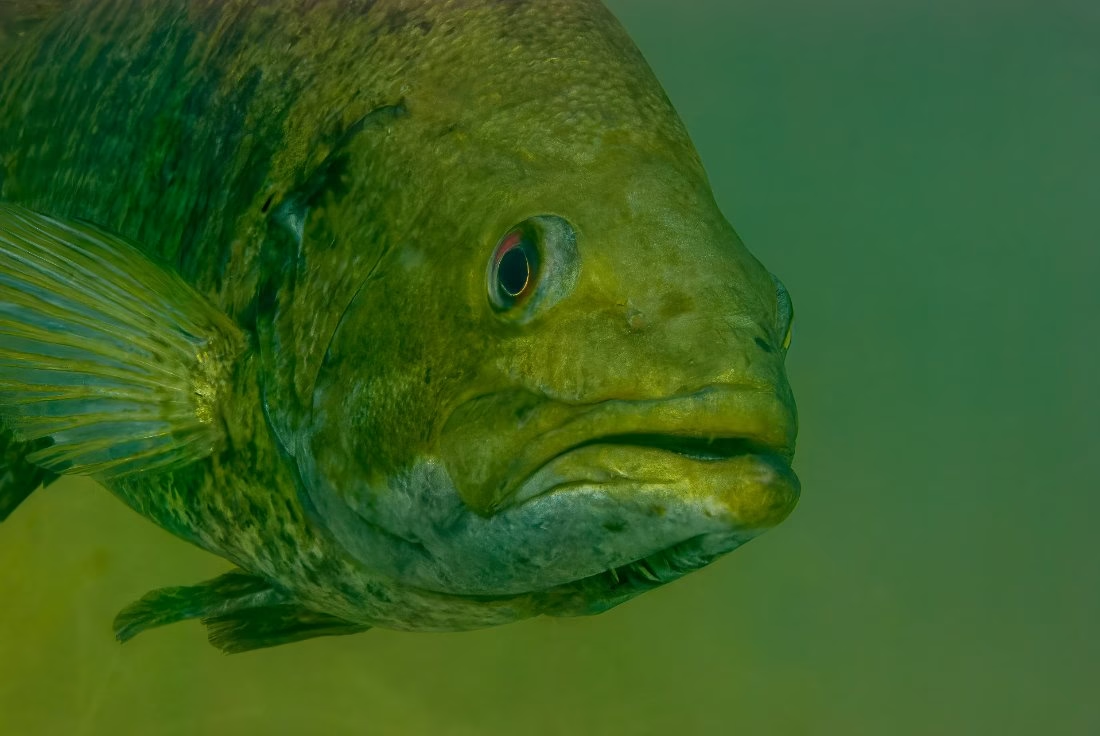
Winter (below 45°F): slow and deep
Bass hold in the deepest comfortable water and barely move. Bites are subtle and rare, but the fish that bite are often big. Fish slowly: a jig dragged on the bottom, a jerkbait with long pauses, or a blade bait near deep structure. Think in terms of one or two bites a day, not twenty.
Pre-spawn (48–58°F): the magic window
This is the best big-fish period of the year. As water warms past 48°F, bass stage on the first depth change next to shallow spawning flats and feed hard to build energy.
Target points, channel swings, and staging cover adjacent to shallow bays. See our confidence-bait lineup for the exact baits.
Spawn (60–72°F): bass move shallow
When water stabilizes in the 60s, bass move onto beds.
Sight-fishing soft plastics (a wacky-rigged stick bait) to visible beds is deadly now. Approach quietly; spawning bass spook easily.
Post-spawn & summer (70°F+): recover, then feed
Right after spawning, females are worn out and tough to catch — fish slow with a soft plastic in slightly deeper water nearby. As full summer sets in, bass split into shallow shade (docks, grass) and deep structure (ledges, humps). Early morning topwater and a deep crankbait or Carolina rig in the heat both produce.
Fall (cooling through the 60s and 50s): the feed-up
As water cools back through the 60s, bass chase baitfish shallow to bulk up for winter. Match the forage with moving baits — spinnerbaits, lipless cranks, and topwater — around schools of shad. It can be the most active fishing of the year, then slows again as water drops below 50°F and the winter pattern returns.
Regional timing
Sources
Sources: BassResource, Outdoor Life, Field & Stream, FishUSA, and On The Water seasonal bass guides.
FAQ
The 52–60°F pre-spawn window produces the most big bass. Bass feed actively from the high 50s through the 70s; below 45°F they slow down and hold deep.
They split between shallow shade (docks, grass, laydowns) early and late, and deep structure (ledges, humps, drop-offs) during the heat of the day.
Slow presentations: a jerkbait with long pauses, a jig dragged on the bottom, or a blade bait. Cold bass won’t chase, so keep it slow and near the bottom.
The quick version
- Fish the thermometer, not the calendar — 55°F fishes like 55°F everywhere.
- 48–58°F pre-spawn is the best big-bass window of the year.
- Bass spawn at 60–72°F in 1–6 ft of water on hard bottom.
- In summer, fish shade early and deep structure midday; in fall, chase shad shallow.
Gear to fish these patterns: best bass lures, best bass rods under $150, best baitcasting reels, best spinning reels, and best braided line.
Gear We Recommend
Here is the gear that makes this easier, ready to shop. As an Amazon Associate, we earn from qualifying purchases.
- Senko / soft plastics — Shop soft plastics
- Squarebill crankbait — See crankbaits
- Spinnerbait — Browse spinnerbaits
- Braided line — Compare braid
- Baitcast combo — See combos