Best Duck Decoys for 2026: 6 Picks for a Southern Spread
Six duck decoys worth building a 2026 spread around, from a budget mallard six-pack to a spinning-wing drake, with spread sizes, rigging and cost per decoy.
Get Out Mor is reader-supported. When you buy through links on this page we may earn a small commission at no extra cost to you. As an Amazon Associate I earn from qualifying purchases. See our full disclosure.
Quick answer: for most Southern duck hunters building a mallard spread, the Final Approach Last Pass Mallard Floaters (about $70 for twelve) are the best all-around buy: carvings by 17-time world champion carver Pat Godin, a rugged one-piece HDPE body, and the lowest cost per decoy in this guide at under $6 each. For pressured late-season birds, the Avian-X Topflight Fusion Mallards (about $120 for six) give you six different postures. To fill out a spread on a budget, the Higdon Standard Mallards (about $70 for six) and Hardcore Rugged Series Mallards (about $80 for six) cost $12 to $13 a decoy. Add a six-pack of Avery GHG Pro-Grade Blue-Winged Teal (about $67) for early teal and mixed bags, and one MOJO Baby Mallard spinning-wing drake (about $70) for motion where it is legal.
These picks are research-based: built from manufacturer specs, current Amazon listings and patterns in owner reviews, not from field testing by Get Out Mor. Prices were checked on Amazon in October 2026. Check your opener and splits on our 2026 duck season dates by state page.
The picks at a glance
| Decoy | Pack | Key features | Best for | Amazon rating | Price (Oct 2026) |
|---|---|---|---|---|---|
| Final Approach Last Pass Mallard Floaters | 12 mallards | Compact 12-inch body, Pat Godin carvings, one-piece HDPE | Core of a mallard spread | 4.3 (214) | about $70 |
| Avian-X Topflight Fusion Mallards | 6 mallards, 6 postures | Feeders, swimmer, low and high heads; weight-forward swim keel | Pressured, late-season birds | 5.0 (few ratings) | about $120 |
| Higdon Standard Mallards | 4 drakes, 2 hens | Foam-filled, XHD feather detail | Budget filler, shot-up timber | 4.5 (58) | about $70 |
| Hardcore Rugged Series Mallards | 4 drakes, 2 hens | FowlFlex durable body, WhaleTail keel | Rough handling, current | 5.0 (few ratings) | about $80 |
| Avery GHG Pro-Grade Blue-Winged Teal | 4 drakes, 2 hens | 60/40 Dura-Keel, thumb loops | Early teal season, mixed spreads | 4.7 (12) | about $67 |
| MOJO Baby Mallard Drake | 1 spinning-wing decoy | About 78% scale, 6-volt rechargeable battery and charger, remote-ready | Motion where legal | 4.4 (420+) | about $70 |
Cost per decoy
Decoys are sold in packs of different sizes, so the fairest comparison is the price of each bird on the water. The chart divides each October 2026 Amazon price by the number of decoys in the pack. A spinning-wing decoy costs as much as a full six-pack of floaters, which is why most hunters run one or two at most.
A practical 12-decoy starter spread built from two six-packs, one premium and one budget, costs about $190 to $200 at October 2026 prices. A 24-decoy spread for pressured mid-season birds runs roughly $280 to $490 depending on the mix.
How many duck decoys do you need?
Six to twelve decoys is a working spread for early season and small water such as beaver ponds, flooded timber holes and creek bends. Early birds are naive, and a small, tight group looks natural. Once birds have been shot at, 18 to 36 decoys spread wider and mixed with motion usually work better on open water and big fields of flooded rice or beans. In flooded timber, where birds see only a small opening, a dozen decoys plus water movement is often all you need.
The best duck decoys, pick by pick
Best overall: Final Approach Last Pass Mallard Floaters (12-pack)
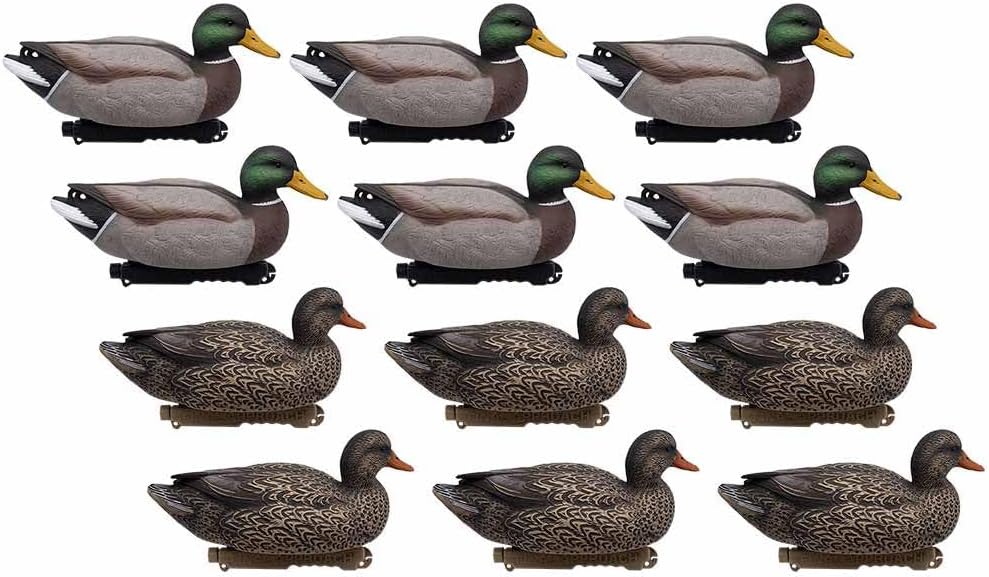
The Last Pass Mallard Floaters get you twelve decoys for about the price of a premium six-pack, which works out to under $6 a decoy, the lowest in this guide. Final Approach says the carvings come from 17-time world champion carver Pat Godin, and the one-piece, high-density polyethylene body has no glued seams to split. They hold a 4.3-star average across more than 200 Amazon ratings. At 12 inches bill to tail they are smaller than standard mallard decoys, so a dozen packs into less space, which helps on a walk-in timber hole or a crowded boat.
Skip it if you hunt big open water where birds need to see your spread from far off; standard or oversize decoys such as the Avian-X Topflight Fusion show up better there. Check price on Amazon →
Most realistic: Avian-X Topflight Fusion Mallards

Late-season mallards have seen every decoy on the flyway, and variety in posture is one of the things that helps. This Avian-X pack gives you six different birds: a surface-feeder hen and drake, a swimmer hen, a low-head drake, and high-head hen and drake, so one rig shows feeding, resting and alert ducks. The paint is a no-flake finish, and a weight-forward swim keel lets the decoys drift and swim in a light breeze instead of sitting still. Avian-X says the bodies self-right after a boat wake. The listing is new and has only a handful of ratings.
Skip it if you hunt early-season teal and wood ducks mostly; you do not need premium mallard postures for naive early birds. Check price on Amazon →
Best budget mallards: Higdon Outdoors Standard Mallards

The Higdon six-pack includes two upright drakes, two resting drakes and two resting hens, a mix that suggests relaxed, feeding birds. Higdon uses deep-textured feather carving and bright, high-contrast paint, and the decoys are foam-filled, so a stray pellet will not sink them. That makes them a good choice for flooded timber, where decoys get shot over at close range. At about $12 a decoy, they are the cheapest way here to add numbers to a mallard spread. They have 4.5 stars from 58 ratings.
Skip it if you hunt big open water in rough weather; larger, higher-riding decoys are easier for birds to see from a distance. Check price on Amazon →
Most durable: Hardcore Rugged Series Standard Mallards
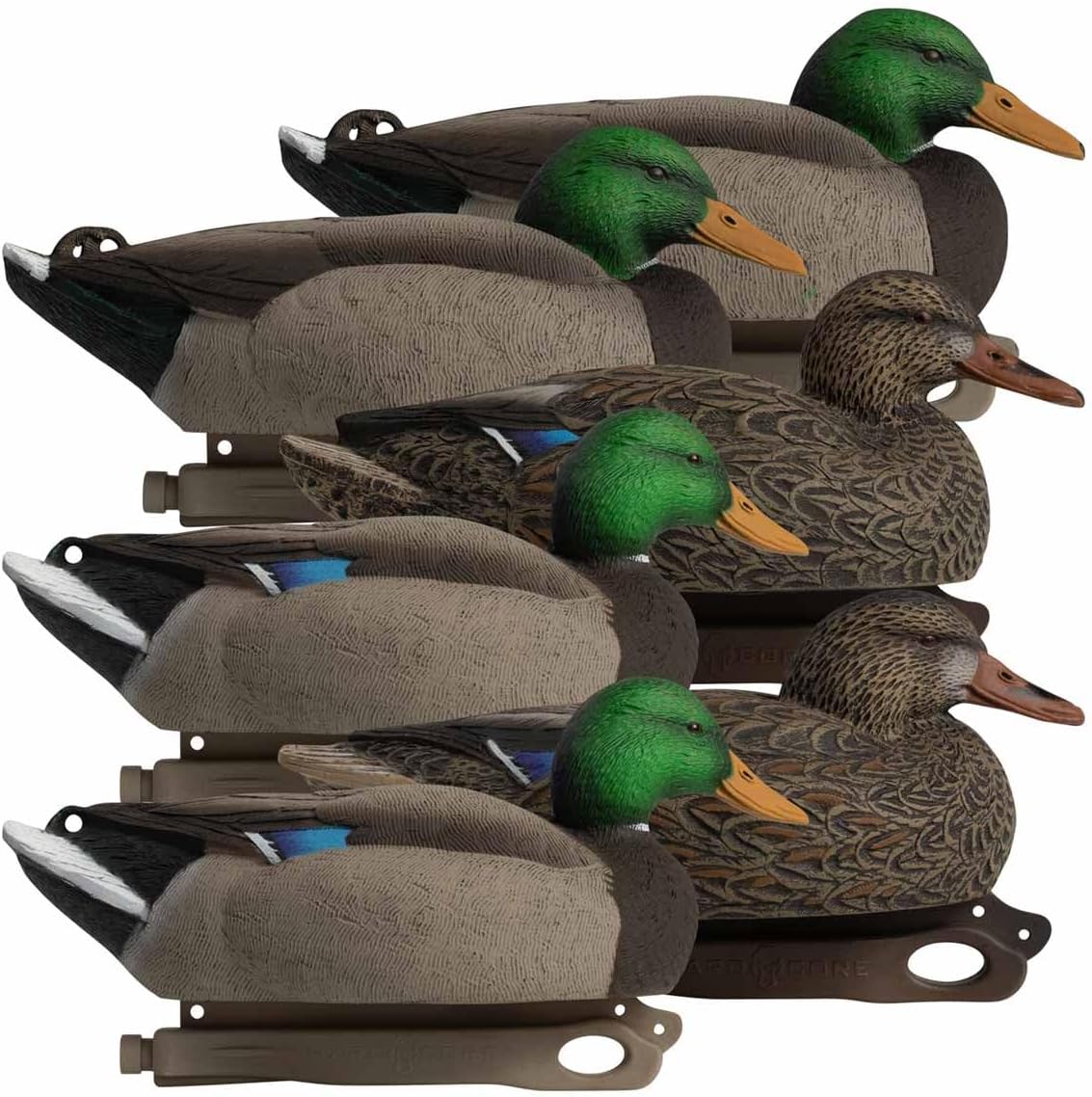
Hardcore built the Rugged Series around its FowlFlex body material, which is designed to flex and spring back instead of cracking when decoys are thrown in a bag, stepped on or tossed into a boat. Each six-pack has two active drakes, two resting drakes, a relaxed hen and a resting hen, with Hardcore’s WhaleTail keel to add movement in light current. At about $13 a decoy, they are a good choice for hunters who walk in to public water with a decoy bag on their back. The listing has a small number of ratings.
Skip it if realism matters more to you than toughness; the Avian-X pack offers more postures and finer detail. Check price on Amazon →
Best teal decoys: Avery GHG Pro-Grade Blue-Winged Teal

Teal often make up a large share of the Southern bag, and a few teal decoys mixed into a mallard spread add realism for mixed flocks. This Avery Greenhead Gear six-pack has two rester drakes, a surface-feeder drake, a high-head drake, a surface-feeder hen and a rester hen. Each uses Avery’s 60/40 Dura-Keel weighting for a stable ride and has thumb loops for quick pickup. It has 4.7 stars on Amazon. Pair it with the early September teal seasons listed on our duck season dates page.
Skip it if you only hunt the regular season over big mallard water; put the money into more mallard decoys instead. Check price on Amazon →
Best motion decoy: MOJO Baby Mallard Drake

Spinning-wing decoys imitate the wing flash of ducks landing, which ducks can see from far away. The Baby MOJO is about 78% the size of MOJO’s full-size mallard, with a dual-shaft direct-drive motor, PVC magnetic wings, and a 6-volt rechargeable battery and charger included. An external charging port means you do not have to take it apart to charge it, and a factory-installed receiver plug lets you add a remote later so you can shut it off when birds are working. It has 4.4 stars from more than 420 ratings.
Motion decoys work best early in the season and on birds that have not seen many of them. On heavily hunted public water, many hunters switch them off once birds are committed. Several states restrict or ban electronic spinning-wing decoys during all or part of the season, so check your state’s waterfowl regulations before you use one.
Skip it if your state or the area you hunt restricts motorized decoys; a jerk cord or a water-moving rippler is the legal alternative there. Check price on Amazon →
Building the spread
Leave a landing hole
Ducks land into the wind. Set your decoys with an open pocket upwind of your blind, close enough that birds finish inside 25 to 30 yards. A common layout is a “U” or “J” shape with the open side facing downwind toward you.
Spacing and placement
Place the closest decoys about 15 yards from the blind and the farthest about 30 to 35 yards, so you can use the decoys as range markers. Space decoys a few feet apart; relaxed ducks spread out, nervous ducks bunch up.
Rigging
Texas rigs, a line through the keel with a sliding weight, are quick to set and pick up and suit most Southern water from 1 to 6 feet deep. In current, tie off to the front keel point so decoys face upstream like real ducks.
Add movement
Still water and still decoys look dead. A jerk cord, a water-moving rippler, or a spinning-wing decoy where legal makes a spread look alive, especially on calm mornings.
When to buy
Decoy prices often rise as seasons approach and stock sells through in October and November, then fall in late winter and spring. If you are building a spread for this season, buy before your opener; Arkansas opens November 21 and Louisiana’s West Zone November 14, according to our 2026 duck season table. If you are planning for next season, late-winter clearance is usually the cheapest time to add to a spread.
Frequently asked questions
How many decoys do I need for duck hunting?
Six to twelve for early season and small water; 18 to 36 for pressured birds on open water.
Are foam-filled decoys worth it?
Yes, if you hunt flooded timber or close-range setups where decoys get hit by shot. A foam-filled decoy stays afloat even with holes in it.
Do spinning-wing decoys really work?
They often help, especially early in the season, but many states restrict them for part or all of the season. Check your state’s regulations first.
Should I use teal decoys in a mallard spread?
A few teal decoys in a mixed spread can add realism, especially in the South where teal, gadwall and mallards often use the same water.
How these picks were chosen
We did not hunt over each of these decoys for this article. The picks are based on manufacturer descriptions, the details and ratings on each Amazon listing, and recurring themes in owner reviews. We checked that each link opens the exact product named and checked prices on Amazon in October 2026. Our full process is at how we pick gear.