How Alligators Find Prey at Night: The Biology of a Nocturnal Apex Predator
If you’ve ever swept a headlamp across a dark bayou and watched two burning orange-red coals stare back at you from the waterline, you already know the feeling. What you might not know is exactly why those eyes light up — and how that same biology makes the American alligator one of the most effective nocturnal predators on the continent. Understanding the mechanics behind an alligator’s night hunt isn’t just interesting science. If you’re planning to hunt them, it’s intel you can use.
Why Alligators Go Nocturnal
American alligators (Alligator mississippiensis) are ectotherms — cold-blooded animals whose body temperature tracks the environment rather than internal metabolism. That single biological fact shapes nearly everything about when and how they hunt.
During the Gulf South summer, daytime air temperatures routinely push past 95°F. Sitting in direct sun on a bank for hours might feel miserable to you, but for a large reptile that absorbs heat from its surroundings, midday is brutally hot even by alligator standards. More importantly, the water warms to temperatures that push prey species — particularly fish — into deeper, cooler zones where they’re harder to ambush efficiently.
Alligators are most active and most aggressive as feeders when temperatures fall in the 82°F–92°F range (28°C–33°C). In summer, that window reliably opens after sunset and holds through the early morning hours. At the same time, the prey species alligators depend on — frogs, fish moving into shallows, small mammals coming to the bank to drink, wading birds roosting low — are themselves most active at night. The alligator’s nocturnal shift isn’t random. It’s a precise behavioral adaptation to where the food is.
When temperatures drop below about 70°F (21°C), alligators stop feeding almost entirely. Below 55°F (13°C), they enter a dormant state, burying themselves in bank dens or sitting motionless on the bottom. This is why alligator hunting seasons across the Southeast are concentrated in late summer and early fall — that’s when the animals are moving, eating, and positioned in patterns that hunters can predict.
The Sensory Arsenal: How They Find Prey in Total Darkness
What makes a gator dangerous at night isn’t aggression — it’s the layered sensory system that lets it locate prey with precision in conditions where you’d be functionally blind. Evolution has given the American alligator five distinct sensory tools for nocturnal hunting, and they work in concert.
The Eyes: Built for Low-Light Ambush
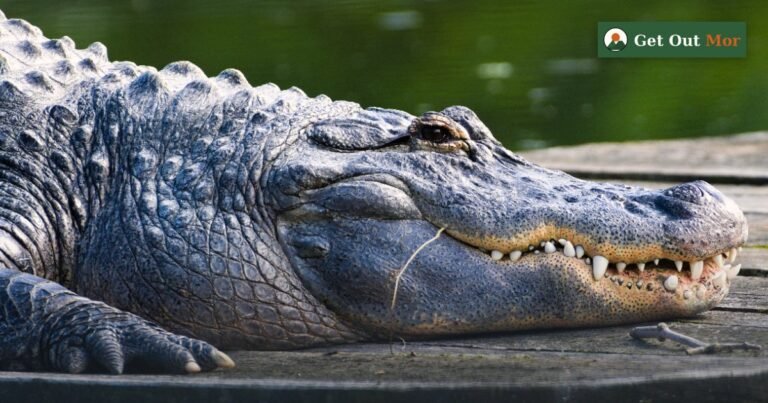
Alligator eyes are positioned high on the skull — elevated enough that an alligator can float with its entire body submerged and still have both eyes and nostrils above the waterline. This isn’t an accident of anatomy. It’s the fundamental architecture of a sit-and-wait predator that needs to monitor the surface environment while remaining nearly invisible.
The structure behind those eyes is what produces the eyeshine that every alligator hunter learns to look for. Alligators possess a tapetum lucidum, a reflective membrane positioned directly behind the retina. When light enters the eye and passes through the retina, the tapetum reflects it back through the photoreceptors a second time — essentially giving the eye two passes at every available photon. The result is dramatically enhanced light sensitivity in low-light conditions.
What separates alligator eyeshine from most of the other animals you’ll spot in the dark is the color. White-tailed deer produce a greenish-white reflection. Most cats run green or yellow. Alligator eyeshine is distinctly red to orange — a characteristic color produced by the specific chemistry and structure of their tapetum lucidum. That orange-red glow is what experienced hunters key on when they’re running spotlights across a lake or creek after dark.
The tapetum lucidum functions as a retroreflector — meaning light returns along almost exactly the same path it came from. This is critical for image quality. Unlike a simple mirror (which scatters reflected light), a retroreflector preserves the coherence of the image, so the alligator isn’t just seeing more light — it’s seeing a sharper image in the dark than it would without the reflective layer.
Alligators have a rod-dominated retina. Rods are the photoreceptors specialized for detecting light intensity rather than color — they’re what humans rely on in dim conditions, and why your own night vision is essentially monochromatic. In an alligator’s eye, the high rod density combined with the tapetum lucidum creates a visual system optimized for detecting motion in low-light environments, not for distinguishing color. An alligator in a dark swamp isn’t reading your orange vest — it’s tracking the ripple your boot made in the mud.
Integumentary Sensory Organs: A Lateral Line for Land and Water
Vision alone doesn’t fully explain what makes an alligator deadly at night. The real secret weapon runs along the jaw.
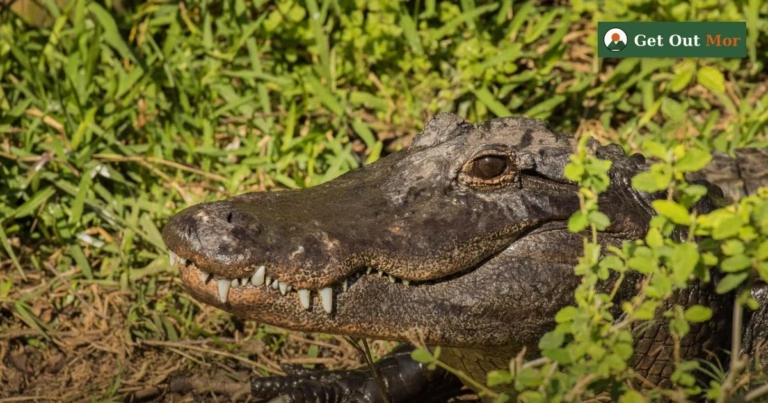
Look closely at an alligator’s snout and lower jaw and you’ll see rows of small dark dots — they look almost like pores or pits embedded in the scales. These are Integumentary Sensory Organs, or ISOs. Described formally in Nature (volume 417, page 241, 2002), ISOs are dome-shaped pressure receptor organs packed with mechanoreceptor cells connected to a dedicated, hypertrophied nerve system. They detect minute disturbances and vibrations in the water — the pressure wave from a fish’s tail beat, the ripple from a frog hitting the surface, the displacement caused by a mammal wading into the shallows.
The sensitivity of ISOs is remarkable. Research suggests they can detect surface disturbances equivalent to a water drop falling from a few centimeters — in total darkness, with no visual input at all. In fossils from the Jurassic period, structures corresponding to ISOs have been identified, meaning this sensory organ predates the dinosaur extinction by tens of millions of years. It’s a system that works.
For a hunting alligator lying motionless in the water at night, ISOs are essentially a distributed pressure map of everything moving near the surface. The animal doesn’t need to see a frog land — it feels the exact location of the impact through its jaw.
The Vomeronasal Organ: Chemical Tracking
Alligators possess a vomeronasal organ (also called Jacobson’s organ), a chemical detection system located in the roof of the mouth. While the vomeronasal organ is more prominent in snakes and lizards, alligators use it to process chemical signals dissolved in water — essentially tracking the scent trail of prey moving upstream or through their territory.
This becomes particularly relevant in low-visibility water conditions — murky bayous, tannin-stained creeks, flooded timber — where visual detection is limited even with a tapetum lucidum. A fish that’s bleeding, a bird that’s been struggling on the surface, a mammal carcass in the current: all of these leave chemical signatures that an alligator can follow.
Hearing and Thermoreception
Alligators hear through a tympanic membrane located just behind each eye, and their hearing range overlaps well with the frequencies produced by prey species moving in or near water. They’re sensitive to low-frequency vibrations in particular — the deep thud of a large fish, the splashing of a struggling animal.
There’s also evidence that crocodilians have some capacity for thermoreception — the ability to detect infrared radiation (heat) through facial pit organs similar in function to those of pit vipers, though less well-developed. The jury is still somewhat out on how significant this is for active hunting, but it may contribute to detection of warm-blooded prey (mammals, birds) in water close to the animal’s body temperature.
The Sensory System at a Glance
| Sense | Capability | How It’s Used to Hunt at Night |
|---|---|---|
| Vision / Tapetum lucidum | Retroreflective layer doubles photon capture; rod-dominated retina maximizes light sensitivity | Detects motion and silhouettes at the waterline in near-darkness; produces the orange-red eyeshine hunters use to locate gators |
| Integumentary Sensory Organs (ISOs) | Dome-shaped pressure receptors along jaw and snout; detect minute surface vibrations and water disturbances | Pinpoints exact location of prey movement in or on water, even in total darkness and murky conditions |
| Vomeronasal organ (smell) | Chemical detection via Jacobson’s organ in the roof of the mouth | Tracks scent trails of prey dissolved in water; useful in low-visibility, stained-water environments |
| Hearing | Tympanic membrane behind each eye; sensitive to low-frequency vibrations | Detects splashing, struggling prey, and low-frequency movement in water |
| Thermoreception | Possible infrared sensitivity via facial pit structures | May assist in detecting warm-blooded prey (mammals, wading birds) in water near body temperature |
The Hunt Itself: Patience as a Weapon
With all of that sensory capability in place, the American alligator’s actual hunting strategy is almost anticlimactic: it waits.
Alligators are sit-and-wait ambush predators. They don’t run prey down, they don’t herd fish, and they don’t make long-distance pursuit strikes. What they do is position themselves in high-probability zones — near shallow bank edges, under overhanging vegetation, at creek confluences where prey concentrates — and hold still until the prey comes to them.
An alligator resting quietly underwater can hold its breath for one to two hours when not exerting itself. In practical terms, this means a large alligator can lie motionless on the bottom of a shallow creek at night, monitoring the surface with its ISOs, and remain completely invisible to every prey species in the vicinity until it decides to move.
The strike itself is triggered by the combination of sensory inputs described above — ISOs fire from the vibration, the eyes lock onto the motion, and the alligator launches from a resting position with a burst of tail-driven acceleration that’s over before most prey species can register what happened. The jaw closes with a crushing force measured in the thousands of pounds per square inch for large adults.
The diet is opportunistic across the seasons: fish, turtles, frogs, invertebrates, wading birds, and small to medium mammals. Large adults are capable of taking deer, feral hogs, and domestic livestock at the waterline. The alligator doesn’t have a preference — it eats what presents itself.
An Alligator Head: Anatomy of a Nocturnal Predator
The diagram below shows the key structures discussed in this article as they appear in a side-view cross-section of the head.
Side-view diagram of an American alligator’s head showing the key sensory structures used during nocturnal hunting.
What This Means for Hunters
The biology described above has direct, practical implications for anyone who plans to hunt alligators — or simply encounter them safely while hunting or fishing at night.
The eyeshine technique is based on hard science. When you run a spotlight or headlamp across dark water, you’re exploiting the tapetum lucidum directly. The retroreflective layer sends light right back to your eye along the same angle you shone it. Red or orange color equals alligator. Green or yellow equals most mammals. Learn the difference and you’ll stop misidentifying otter, nutria, and deer before you ever get the boat close.
Distance estimation from eyeshine. Experienced hunters learn to estimate size from the distance between the eyes at the surface. A rough rule: the spacing in inches between the eyes at the surface roughly corresponds to the total length in feet of the alligator. A gator with eyes four inches apart is likely in the four-foot range. Eyes eight inches apart — eight feet, give or take. It’s not a precise measurement tool, but it helps you quickly sort juveniles from trophy animals without getting close.
Vibration discipline matters. Given how sensitive ISO organs are, alligators are well aware of boat engines, paddles striking the gunwale, and anyone stomping around a bank. Approach on electric trolling motors or by paddling, cut the motor well before you reach the animal, and move deliberately. An alligator that detects vibrations and submerges before you can close the distance is a hunt that’s over before it started.
Temperature windows drive activity. If you’re planning a hunt or a scouting trip, pay attention to the overnight low. Nights that stay above 75°F are your best opportunities for active animals. A cold front that drops temperatures below 70°F will shut down feeding almost immediately. Alligator hunting is a warm-weather pursuit for a reason — the biology demands it.
Seasons and regulations. Alligator hunting is tightly regulated across every state in the Southeast. The American alligator carries a CITES Appendix II listing, which means even domestically hunted animals require regulated documentation for any commercial trade. State agencies — including the Florida Fish and Wildlife Conservation Commission, Louisiana Department of Wildlife and Fisheries, and equivalent agencies in Georgia, Texas, South Carolina, and Mississippi — set annual season dates, tag allocations, and legal methods. Check current regulations before you go.
Frequently Asked Questions
Why do alligator eyes glow red at night instead of green like deer?
The color of eyeshine is determined by the specific structure, pigmentation, and chemistry of the tapetum lucidum. Alligators’ tapetum produces an orange-red reflection due to the characteristics of the reflective cells and the overlying retinal tissue. Most mammals — including deer, raccoons, and most cats — produce a green or yellow reflection. The red-orange color is distinctive enough that experienced hunters use it as the primary identification marker when spotlighting.
Can alligators actually see well in the dark, or do they just sense vibration?
Both, used together. The tapetum lucidum and rod-dominated retina give alligators genuinely good low-light vision — better than human night vision, though not as refined as a cat’s. The ISO pressure system operates independently and can locate prey even in total darkness. In practice, both systems fire simultaneously when an alligator is hunting, giving it redundant sensory coverage.
How close can an alligator detect prey with its ISO organs?
Research suggests ISOs are sensitive enough to detect surface disturbances equivalent to a water drop falling from a short distance. In the open water of a swamp or lake, an alligator can likely detect the pressure wave from a fish’s tail beat or a frog’s entry splash from several feet away, though the exact effective range is difficult to measure precisely in the field.
Do alligators hunt in cold weather?
Not effectively. Alligators stop feeding when ambient temperatures drop below approximately 70°F (21°C) and enter a dormant state below 55°F (13°C). Their metabolism slows to the point where they simply don’t need to eat, and their sensory and physical systems operate at reduced efficiency in the cold. This is why you don’t see alligator hunting seasons scheduled in winter months across any Southern state.
What do alligators eat most often?
Their diet is highly opportunistic and shifts with age. Juveniles eat primarily invertebrates, small fish, and frogs. Adults take fish, turtles, wading birds, and small to medium mammals. Large adults — ten feet and over — are capable of taking deer and feral hogs that come to the water’s edge. Prey is consumed whole or in large pieces; alligators don’t chew.
Is spotlighting alligators legal for hunters?
In most states that have legal alligator hunting seasons, spotlighting (using artificial lights to locate eyeshine) is not only legal — it’s the primary method prescribed for night hunting. Specific legal methods vary by state, so consult your state wildlife agency for current rules. The technique exploits the tapetum lucidum directly, and it’s the most reliable way to locate animals on dark water.
How do I tell a large alligator from a small one at night using eyeshine alone?
The primary cue is the distance between the two eyes as they appear at the water’s surface. Many experienced hunters use the rough rule that the inter-eye spacing in inches approximates total body length in feet. A gator with eyes twelve inches apart is likely near twelve feet in length. This is an approximation — angle of view, body posture, and water depth all introduce error — but it’s a useful quick read for sorting trophy-class animals from juveniles before you get the boat within harpoon or snare range.